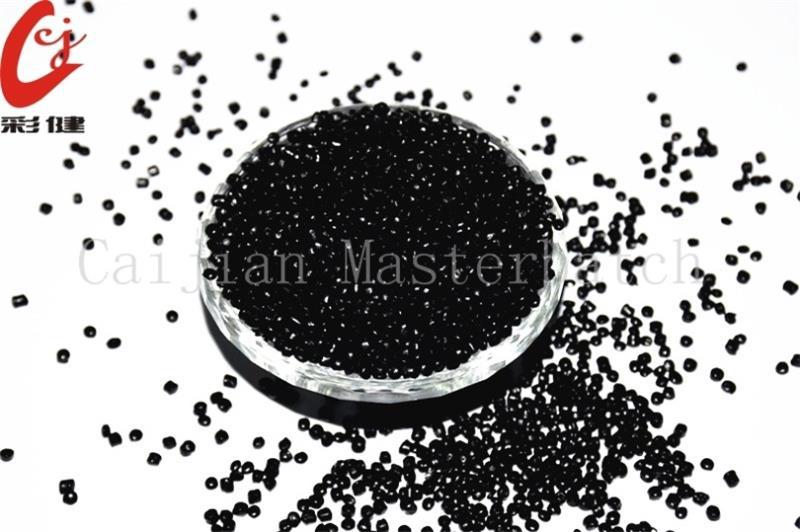
Anti-block masterbatch consists of a carrier resin, an anti-blocking or slip agent and various additives. The main agents are:
Oleamide: small molecules that bloom quickly, with good lubricity and low cost (some domestic grades cost only a dozen yuan per kg), but it yellows very easily, has poor heat resistance, migrates to the film surface and has a short effective life, seriously affecting product quality; excessive blooming also hurts printing and heat sealing. It is the raw material of many low-quality slip masterbatches.
Erucamide: more carbon atoms and a higher molecular weight, relatively stable, with good lubricity, less yellowing, better heat resistance and a longer effective life; it may still yellow slightly over time, and costs more.
Micronised SiO2: the choice of silica matters a great deal. It must give good anti-blocking at low dosage, with a suitable particle size and a refractive index close to that of the film resin; it must also disperse easily, because agglomerated silica harms the appearance, optical properties and printability of the film.
Beyond anti-blocking performance, choosing a slip/anti-block masterbatch also involves:
1. Optical properties: for the best clarity and lowest haze, choose an agent whose refractive index is close to the resin (1.49), with a narrow and suitable particle size distribution, so that a small dosage achieves the required opening effect.
2. Dispersion: particle size is critical. Smaller particles disperse less easily, while larger ones harm appearance and optics; 2-10 microns is typical, which requires the masterbatch producer to have high-dispersion twin-screw equipment and rich experience.
3. Heat sealing and printing: film is usually corona or flame treated before sealing and printing to raise surface tension and energy, but excess slip agent migrates to the surface and harms seal strength and ink adhesion. Converters with strict requirements can use low-friction, non-migrating grades.
4. Scratch resistance of metallised film: to prevent hard inorganic particles from piercing the film and weakening the water-vapour and oxygen barrier, round and soft particles can be used.
5. Machine wear: some inorganic anti-block agents are hard and wear equipment heavily, which film makers should watch.
6. Screen blockage: if the pressure differential across the filter rises sharply, consider changing the masterbatch.
7. Price: cost is the key factor once the basic performance requirements are met.
National hotline
0769-87770836
Email: dgchainkey@126.com
Mobile: 13829293783
Tel: 0769-87770836
Address: Bai Shabu Shatangwei Section, Daling Street, Huidong County, Huizhou City, Guangdong, China
Copyright © Dongguan Caijian Plastic Products Co., Ltd. All rights reserved.Address: Bai Shabu Shatangwei Section, Daling Street, Huidong County, Huizhou City, Guangdong, China ICP filing: 粤ICP备17023499号-3